
When Luxury Becomes Cultural Choice
For decades, luxury in China followed a familiar script. European maisons symbolized success, social ascent, and global belonging. Logos functioned as passports into a world of visible prestige. To consume luxury was to consume an idea of elsewhere.
That narrative is now quietly dissolving.
A new generation of Chinese consumers is turning inward — not out of nationalism or rejection of the West, but out of discernment. What they are seeking today is not imported validation, but cultural resonance. Luxury, in this emerging consciousness, is no longer about where a product comes from, but what it represents.
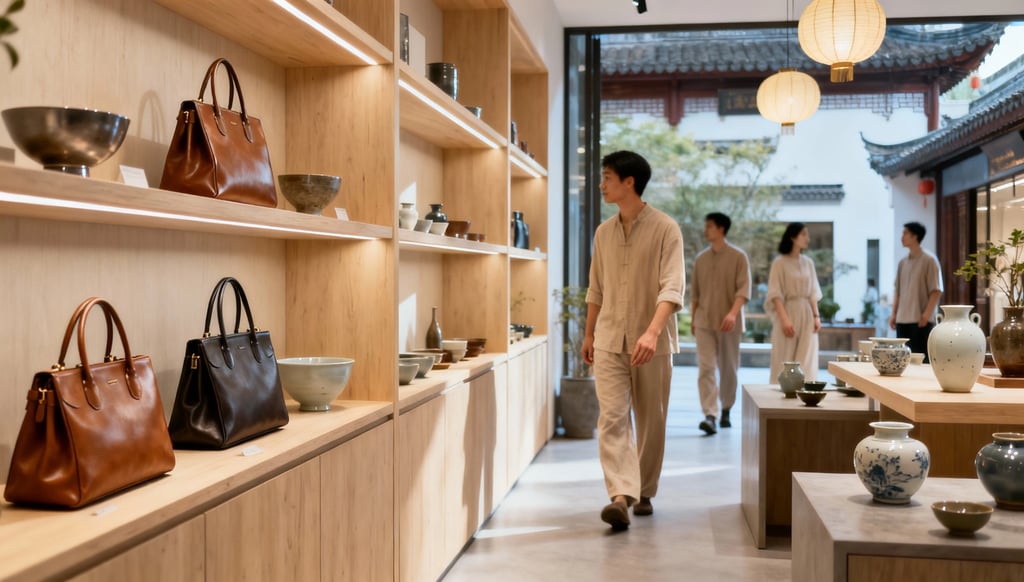
Brands like Laopu Gold and Songmont embody this shift. Their success is not driven by price accessibility or trend mimicry, but by something far more structural: cultural identity, craftsmanship, and intrinsic product value. These brands are thriving precisely because they are not trying to look European. They are articulating a contemporary Chinese aesthetic on their own terms.
This transformation is economic as much as it is cultural. Choosing domestic luxury is also an act of economic sovereignty. It strengthens local industries, preserves technical know-how, and keeps value circulating within the national ecosystem. Luxury consumption, here, becomes a form of quiet investment — in culture, in people, in continuity.
The extraordinary growth figures of Laopu Gold — triple-digit revenue increases and rapidly expanding international presence — are not anomalies. They are signals. They reflect a consumer base that is increasingly prioritizing craftsmanship, materials, innovation, and storytelling over logos and global brand hierarchies.
What is particularly striking is that this shift is happening in parallel with a rejection of ostentation. Chinese consumers are moving away from conspicuous status signaling toward what might be called aesthetic sovereignty — the freedom to define beauty, quality, and prestige outside inherited Western frameworks.
In this context, Bernard Arnault’s visits to Laopu Gold and Songmont take on a deeper symbolic meaning. They are not simply acts of market research. They are acknowledgments that cultural authority in luxury is no longer unidirectional. The center of gravity is no longer fixed in Paris or Milan. It is becoming plural.
This is not about replacing foreign luxury with domestic luxury. It is about redefining luxury itself. About shifting from external validation to internal coherence. From spectacle to substance. From inherited prestige to chosen meaning.
Luxury, in its most contemporary form, is no longer a badge.
It is a position.
And in China today, that position is increasingly being shaped by cultural confidence, economic autonomy, and a renewed intimacy with craftsmanship.
BLE — Editorial Notes
—